
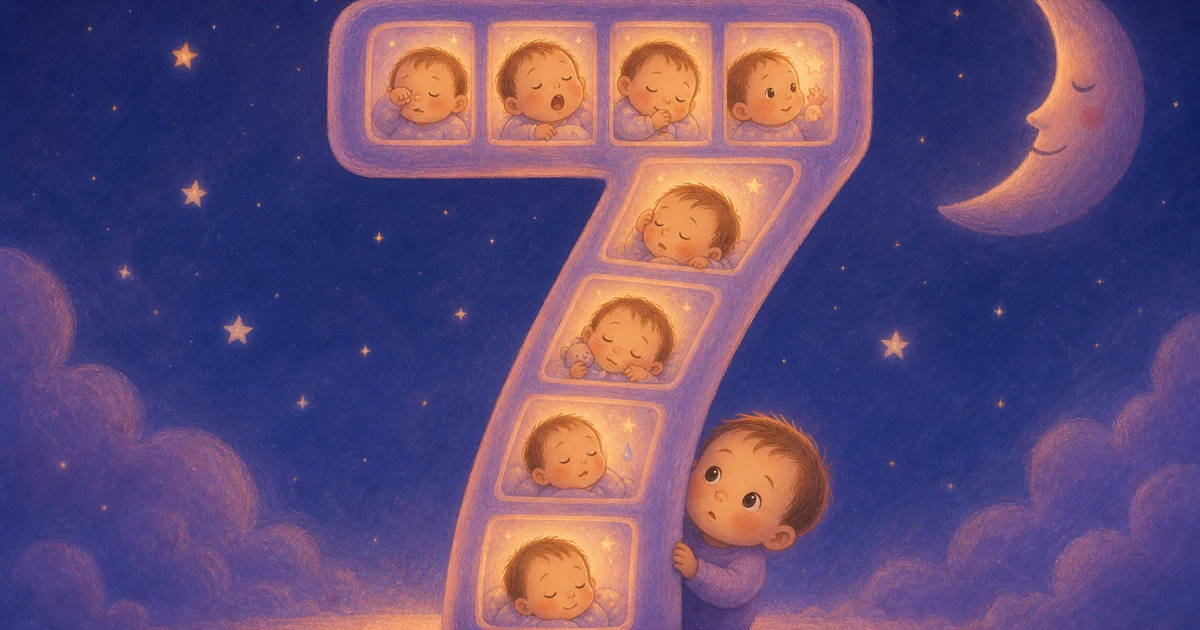
Overtired Baby: 7 Signs You're Missing the Window
Grzegorz Oksiuta • May 19, 2026
In this article:
- Why is my baby fighting sleep when they're clearly exhausted?
- Was your baby sleeping better before this started?
- Why does an overtired baby sleep worse, not better?
- What are the 7 signs your baby is overtired?
- How do you settle an overtired baby right now?
- What makes an overtired baby worse?
- How long does it take an overtired baby to recover?
- What this means for you tonight
- Frequently asked questions
- Sources
Overtired baby signs (cluster yawning, a glassy stare, sudden fussiness, then a wired "second wind") mean your baby has pushed past their ideal wake window. Infants aged 4 months and up need 12 to 16 hours of sleep per 24 hours,¹ and once you miss the window, elevated arousal makes an overtired baby harder to settle, not easier.
Why is my baby fighting sleep when they're clearly exhausted?
It's 2am, or the tail end of a nap that never happened. Your baby is rubbing their eyes, arching their back, screaming. Every time you lay them down, they wind up tighter instead of softer. Into the crib they go. Forty-five minutes later they're awake and furious all over again. And you start doing the math no exhausted parent should have to do: keep them up longer to tire them out, or put them down sooner?
You're not imagining it, and you're not doing it wrong. One parent on r/beyondthebump nailed it: "Drowsy but awake does not work with him and I can't keep trying it because then he's overtired and screams harder... it's a full on battle." (r/beyondthebump) That "the harder I try, the worse it gets" spiral is the signature of a baby who is past the window, not short of tired.
Was your baby sleeping better before this started?
Usually, yes. A few days ago naps were landing and bedtime took ten minutes. Then something slipped: a morning nap skipped for an appointment, a late bedtime, a short stroller nap on a big day out. None of those alone wrecks anything. But they don't cancel out either. (If the disruption lined up with a predictable rough patch, a 4-month sleep regression can stack on top of ordinary overtiredness.)
Here's why it snowballs: overtiredness builds across the day. A first wake window that ran too long, or a missed morning nap, leaves your baby starting the next stretch already in the red, and every window after that piles on more debt. By late afternoon, a baby who was only mildly short on sleep at 9am can be genuinely dysregulated. That's why the first nap carries so much weight. The morning nap is usually the most restorative, and the first wake window (often the shortest of the day, around 45 to 60 minutes for a young infant) sets the tone for everything after it. A steady baby nap schedule by age is the simplest way to stop that debt from building. Protect the front of the day and the back tends to hold.
Why does an overtired baby sleep worse, not better?
Keeping a baby up to "make them more tired" feels logical. It backfires almost every time. Two things are working against you, and neither is the one most blogs name.
First, timing. Everyone gets an evening second wind, babies included. As Dr. Craig Canapari, MD, Director of the Yale Pediatric Sleep Program, puts it: "Everyone gets a second wind in the evening when they feel more awake. If you put your child down during this period, she will not fall asleep."⁹ That's the body clock actively promoting wakefulness in the early evening. Sleep runs on two processes at once: the pressure that builds the longer you're awake, and a circadian signal that gates when sleep comes easily.⁴ High sleep pressure alone won't buy you an easy bedtime if the timing lands in that wakeful zone.
Second, arousal. Elevated cortisol and physiological arousal near sleep time are associated with harder settling and more night wakings, and sleep loss itself is known to raise the next evening's cortisol.⁵ ⁶ That's an association, not proof of a one-way "cortisol surge" in your baby. But it fits what you see in the crib: a baby who reads as wired rather than sleepy.
And the classic tell, the baby who goes down and then pops awake around 45 minutes later? That's one full sleep cycle. Infant sleep cycles run about 47 to 50 minutes,² so your baby completes a cycle, surfaces into light sleep, and can't yet bridge into the next one. The fix isn't more awake time. It's catching the window earlier.
What are the 7 signs your baby is overtired?
The whole skill is catching the early cues, when you still have runway, instead of the late ones, when the window has already slammed shut. The signs run roughly in order, from "you have a few minutes" to "you're past it."
- Yawning in clusters (early). One yawn is noise. Two or three in quick succession is signal. The AAP lists yawning among the drowsy cues to watch for.¹⁰
- Staring or zoning out (early to mid). Your baby stops tracking your face and gazes into the middle distance, eyes glazed. The brain is disengaging from stimulation.
- Slowing down (mid). A baby who was kicking, reaching, and babbling goes quieter and less physical as the nervous system shifts toward sleep.
- Rubbing eyes, ears, or face (mid). A reliable self-soothing tiredness cue. One caveat: ear-pulling can also mean teething or an ear infection, so read it in context. At the end of a wake window with no illness signs, it's almost always sleep.
- Losing interest in play (mid). Toys that were fascinating five minutes ago get dropped or ignored. Your baby is turning inward.
- Fussiness or clinginess (late). Suddenly harder to put down, more vocal, more demanding. If a feed was recent, this is usually the window closing, not hunger.
- Second wind (past the window). Your baby flips from fussy to inexplicably wired: bouncing, frantic, almost giddy. This is the hardest state to wind down from, and it ties straight back to that evening wakefulness surge. From here, settling takes a dark room, patience, and time.
Catch signs one through three and the rest of this article is mostly insurance. Catch sign seven and you're doing damage control.
How do you settle an overtired baby right now?
Work from the least effortful move to the most, and stop the moment something works.
- Stop the stimulation. No more bouncing, talking, or toys. When a baby is already over the edge, more input only adds to the arousal load you're trying to bring down.
- Go dark and quiet. Draw the blackout curtains (darkness supports melatonin) and use white noise safely. Keep it under 50 dBA, place the machine as far from the crib as possible (never in or on the crib), at low volume and for a short duration. In testing, most sound machines still exceeded 50 dBA even at 200 cm away,³ ⁷ so treat distance as "as far as you can," not a safe threshold.
- Swaddle, if your baby isn't rolling yet. For young babies not yet showing rolling, a swaddle can contain the startle reflex that keeps jolting them awake. Stop swaddling at the first signs of rolling, usually around 3 to 4 months (or earlier).⁸
- Add brief motion. Rocking, a gentle bounce, or a short stroller walk can bring arousal down enough for sleep to take. The goal is calm-enough-to-sleep, not replacing your baby's ability to settle.
- Extend the next wake window a little. Once you're past this nap, add 10 to 15 minutes to the following window to rebuild enough sleep pressure for a cleaner next attempt.
Before you troubleshoot, make sure you're solving the right problem. Overtired isn't the only reason a baby melts down.
| Timing in wake window | Cry pattern | Resolves when... | Other tells | |
|---|---|---|---|---|
| Overtired | End of a full window | Escalates fast, hard to interrupt | Baby is finally asleep | Sleepy cues came first; wakes ~45 min later; arching back |
| Undertired | Early, before the window closes | Protest, not distress; good mood | You wait and try later | Playful and alert; fought naps, 20-min catnaps, split nights |
| Hunger | Any time, often first half | Rhythmic, building; rooting | You feed | Hand to mouth; predictable feed gaps |
| Illness / teething | Any time, all day | Inconsolable despite good timing | Nothing reliably helps | Fever, ear-pulling, off feeds, behavior changed across the day |
If your baby is inconsolable, has a fever, is pulling at their ears, or their feeding or breathing has changed, treat it as possible illness and call your pediatrician rather than assuming it's a sleep problem. Waiting it out as "just overtired" can delay care your baby actually needs.
What makes an overtired baby worse?
Four moves reliably backfire:
- Keeping them up longer to tire them out. This pushes further into the evening wakefulness surge and higher arousal, so settling gets harder, not easier.⁹ ⁴ ⁵
- Adding screens, play, or excitement at the end of a wake window. More input raises the arousal you're trying to bring down.
- Cranking white noise loud or moving it close to the crib. Over 50 dBA or in the crib is a hearing-safety and arousal risk.³ ⁷
- Chasing the clock on a debt day. When your baby is already overtired, a rigid schedule works against you. Pull the next sleep earlier instead.
How long does it take an overtired baby to recover?
Not long. And this is worth holding onto at 2am: one well-timed sleep noticeably lowers the load, and full recovery from a rough overtired stretch usually takes one to two days of consistent, well-timed sleep. Sleep is what restores the stress system that overtiredness winds up.⁵ If you're not sure whether your baby is simply behind on rest, our guide to whether your baby is sleeping enough walks through the daily totals by age.
Expect slightly shorter wake windows the day after a hard night. Your baby is carrying a little debt, so follow their cues rather than the clock for a day. This is a timing state, not damage. It passes.
What this means for you tonight
Three moves, in order of how far out they are.
- Right now: dark room, white noise under 50 dBA and as far from the crib as you can manage, minimal handling. If your baby is very dysregulated, a brief bit of motion to take the edge off.
- Tomorrow: protect the first nap and watch that first wake window closely. It sets up the whole day.
- This week: track wake windows so you're catching signs one through three, not sign seven.
Use the age ranges below as a starting reference point, then adjust to your own baby. For clock-time examples and how the ranges shift, see our full wake windows by age guide, or browse more baby sleep resources.
| Age | Wake window |
|---|---|
| 0–3 months | 60–120 min (first window of the day often 45–60 min) |
| 3–5 months | 1.5–2 hours (90–120 min) |
| 5–8 months | 2–3 hours |
| 8–12 months | 2.5–3.5 hours (evening window can reach ~4 hrs) |
By the 8 to 12 month stage, most babies settle into two predictable naps, which makes the window far easier to read.
Frequently asked questions
Can a baby be overtired and not show obvious signs?
Yes. Some babies, especially temperamentally sensitive ones, stay outwardly calm while running short on sleep. The clearest retrospective tell is a baby who takes a long time to fall asleep, or who wakes after a single sleep cycle (around 45 minutes) despite seeming fine when the nap started.² If that pattern repeats on days the schedule slipped, overtiredness is the likely explanation even without the classic cues.
What's the difference between an overtired and an undertired baby?
They look similar (both fight sleep) but timing and mood differ. An overtired baby fights at the end of a full wake window, usually after sleepy cues, then often wakes about 45 minutes in. An undertired baby fights early, stays in a good mood, and gives you fought naps, 20-minute catnaps, or "split nights" where they're wide awake and content in the middle of the night. Playful and alert while resisting means try a slightly longer window. Melting down with heavy eyes means move faster.
My baby fights every nap. Is that always overtiredness?
Not always. Nap resistance can also come from a wake window that's too short, a sleep environment issue, or a developmental leap. The tell is timing: fighting at the end of a full window with sleepy cues points to overtired; fighting 20 to 30 minutes in while still cheerful points to undertired and a window that needs to stretch.
How long does it take an overtired baby to recover?
One well-timed stretch of sleep lowers the load considerably. Full recovery from a rough overtired stretch usually takes one to two days of consistent, well-timed sleep, with slightly shorter wake windows the day after. That's normal and temporary.
At what age do wake windows become predictable?
Most parents find wake windows steady out between 4 and 6 months, as babies consolidate from 4 to 5 naps down to 3, then eventually 2. By around 9 months, a two-nap, roughly by-the-clock schedule becomes reliable for most babies. Before 4 months, rhythms are still maturing and windows shift day to day.
Sources
- American Academy of Pediatrics. "AAP Endorses New Recommendations on Sleep Times." AAP News, 2016. Infants 4 to 12 months should sleep 12 to 16 hours per 24 hours, including naps (AASM consensus, endorsed by AAP). https://publications.aap.org/aapnews/news/6630/AAP-endorses-new-recommendations-on-sleep-times (Parent-facing: HealthyChildren.org, "Healthy Sleep Habits: How Many Hours Does Your Child Need?" https://www.healthychildren.org/English/healthy-living/sleep/Pages/healthy-sleep-habits-how-many-hours-does-your-child-need.aspx)
- Allen KA. "Promoting and Protecting Infant Sleep." Advances in Neonatal Care, 2012;12(5):288–291. Infant sleep cycle averages ~47 minutes at term and ~50 minutes at 12 and 24 weeks. https://pmc.ncbi.nlm.nih.gov/articles/PMC3439810/
- Hugh SC, Wolter NE, Propst EJ, Gordon KA, Cushing SL, Papsin BC. "Infant Sleep Machines and Hazardous Sound Pressure Levels." Pediatrics, 2014;133(4):677–681. All 14 machines tested exceeded 50 dBA at 30 cm; most still exceeded 50 dBA at 200 cm. https://pubmed.ncbi.nlm.nih.gov/24590753/
- Borbély A. "The Two-Process Model of Sleep Regulation: Beginnings and Outlook." Journal of Sleep Research, 2022;31(4):e13598. Homeostatic sleep pressure and circadian gating together determine when sleep comes easily. https://pmc.ncbi.nlm.nih.gov/articles/PMC9540767/
- Balbo M, Leproult R, Van Cauter E. "Impact of Sleep and Its Disturbances on Hypothalamo-Pituitary-Adrenal Axis Activity." International Journal of Endocrinology, 2010;2010:759234. Sleep onset inhibits cortisol; evening cortisol while awake correlates with next-night awakenings; cortisol tracks arousal. https://pmc.ncbi.nlm.nih.gov/articles/PMC2902103/
- Leproult R, Copinschi G, Buxton O, Van Cauter E. "Sleep Loss Results in an Elevation of Cortisol Levels the Next Evening." SLEEP, 1997;20(10):865–870. https://pubmed.ncbi.nlm.nih.gov/9415946/
- American Academy of Pediatrics (Council on Environmental Health and Climate Change; Section on Otolaryngology–Head and Neck Surgery). "Preventing Excessive Noise Exposure in Infants, Children, and Adolescents." Pediatrics, 2023;152(5):e2023063752. https://publications.aap.org/pediatrics/article/152/5/e2023063752/194468/Preventing-Excessive-Noise-Exposure-in-Infants
- HealthyChildren.org (AAP). "A Parent's Guide to Safe Sleep," updated 2026. Stop swaddling at the first signs of rolling, usually around 3 to 4 months (or earlier). https://www.healthychildren.org/English/ages-stages/baby/sleep/Pages/A-Parents-Guide-to-Safe-Sleep.aspx
- Canapari C, MD (Director, Yale Pediatric Sleep Program). "Sleep Training Mistakes and Pitfalls." drcraigcanapari.com. https://drcraigcanapari.com/sleep-training-mistakes-and-pitfalls/
- HealthyChildren.org (AAP). "States of Consciousness in Newborns" (drowsy cues: yawn, drooping eyes, stretch, limb-jerk). https://www.healthychildren.org/English/ages-stages/baby/Pages/States-of-Consciousness-in-Newborns.aspx
Catching the window before the meltdown is mostly a timing problem, and timing is hard to eyeball at 2am with a crying baby in your arms. Pelio tracks your baby's wake windows, predicts the next nap, and flags when you're heading toward overtired, so you respond to your baby's real rhythm instead of guessing. Learn more on our baby sleep hub.