
Wake Windows by Age: The Complete Chart (0–3 Years)
Grzegorz Oksiuta • May 13, 2026
In this article:
- What is a wake window, and why does it matter?
- Wake windows by age chart: the complete reference
- Wake Windows and Sleep Pressure Explained
- Wake windows at every age: what to expect stage by stage
- Sleep regressions and wake windows: what changes and what doesn't
- What this means for you tonight
- Quick answers: what parents ask most
- Sources
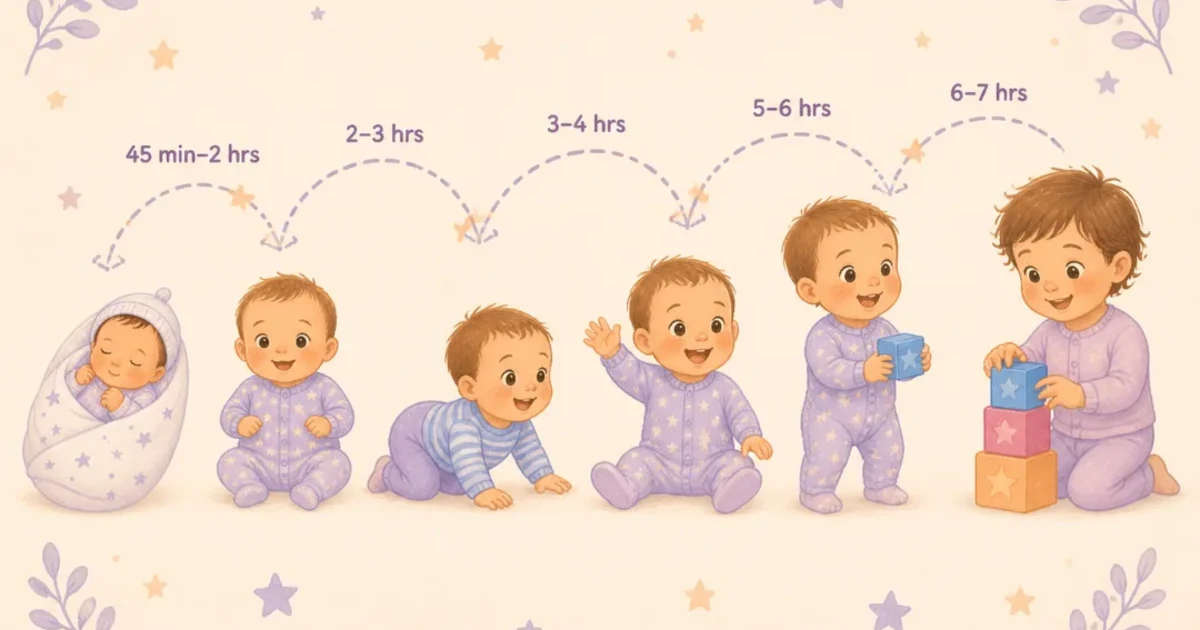
The amount of time your baby can comfortably stay awake between sleep will change with age. It will steadily increase - what works for a newborn will be far too short for a 6-month-old baby, and the schedule that suits a 6-month-old will need to change again by their first birthday. As your baby's brain matures, it will allow them to handle longer stretches of stimulation and activity before needing to sleep.
Wake windows run from roughly 45–60 minutes for a newborn to 5–6 hours for a 3-year-old. Please note that these ranges reflect clinical consensus from sleep research, not formal AAP or AASM recommendations. What matters more is total daily sleep duration; the American Academy of Sleep Medicine recommends 12–16 hours of total daily sleep for infants aged 4–12 months, and 11–14 hours for toddlers aged 1–2 years.¹ For a full breakdown of recommended totals by age, see Is my baby sleeping enough?
What is a wake window, and why does it matter?
In short, a wake window is the amount of time a baby or toddler stays awake; it is the time between waking up from night sleep (or a nap) and falling back to sleep.
Wake windows are quite a useful concept. They help predict when the best time is to put your baby to sleep.
During awake time, the brain builds a drive to sleep - tiredness. Too short a window means baby is not tired enough for a solid nap or a decent night sleep. Too long a window makes a baby overtired and genuinely harder to settle.
Due to baby's development, clock schedules quickly become outdated. Wake windows lengthen as your baby's brain matures, and a schedule should shift with it.
Wake windows by age chart: the complete reference
The chart below should be treated as a practical reference covering age brackets from newborn through 3 years old. Consider wake window as a maximum comfortable awake time rather than a fixed target you need to hit to the minute.
| Age | Wake Window | Naps Per Day | Total Daily Sleep | Key Notes |
|---|---|---|---|---|
| 0–4 weeks | 45–60 min | 4–6 | 14–17 h* | Windows very short; watch for early sleepy cues |
| 1–2 months | 60–90 min | 4–5 | 14–17 h* | Still newborn range; variation is wide |
| 2–3 months | 75–90 min | 4–5 | 14–16 h* | Windows beginning to lengthen |
| 3–4 months | 75–120 min | 3–4 | 12–16 h | 4-month regression period* |
| 4–5 months | 90–120 min | 3–4 | 12–16 h | Post-regression: windows lengthen noticeably |
| 5–6 months | 2–2.5 h | 3 | 12–16 h | 4-to-3 nap transition completing |
| 6–7 months | 2–2.5 h | 3 | 12–16 h | 3-to-2 transition may begin |
| 7–9 months | 2.5–3.5 h | 2 | 12–15 h | 3-to-2 transition; motor-milestone disruption* |
| 9–12 months | 3–4 h | 2 | 12–15 h | 2-to-1 transition approaching |
| 12–18 months | 3.5–4.5 h | 1–2 | 11–14 h | 2-to-1 transition; 12-month disruption |
| 18–24 months | 4.5–5.5 h | 1 | 11–14 h | Nap refusal common but usually temporary* |
| 2–3 years | 5–6 h | 0–1 | 11–14 h | 1-to-0 nap transition; 2-year behavioral disruption* |
Wake Windows and Sleep Pressure Explained
Infant sleep cycles are shorter than adult sleep cycles. Infant sleep cycles last about 50–60 minutes (range 3–70 min).² As a child grows, cycles lengthen: a 2017 study found that a sleep cycle takes on average about 71 minutes at age 2, rising to 79 minutes at age 5.³ Longer cycles mean the brain can sustain wakefulness longer before needing sleep.
Sleep architecture matures around 3–4 months. Around 3–4 months of a baby's life their sleep architecture changes. The 2-stage sleep cycle that baby had until now, consisting of REM (active sleep) and NREM (deep sleep), becomes more organized. A 4-stage sleep cycle emerges as NREM begins to mature and split into 3 phases. Adult-style sleep staging becomes consolidated around 6 months and stays for the rest of life.⁴ ⁵ ⁶ Until then, the AAP is clear: "Babies do not have regular sleep cycles until approximately 4 months of age."⁵ This change is permanent and is the reason why the 4-month sleep regression happens.
Motor and cognitive milestones accelerate brain stimulation. Your baby's movement - rolling, crawling, pulling to stand - and beginnings of speech all engage the brain and can temporarily alter how quickly a child becomes tired. This is why wake windows sometimes appear to change overnight around major developmental events, such as walking for the first time.
Wake windows at every age: what to expect stage by stage
Newborn (0–3 months): short windows, frequent naps
Newborn wake windows take about 45–60 minutes at 0–4 weeks and extend to 75–90 minutes by 10–12 weeks. For a detailed look at what this looks like in practice day-to-day, see the 3-month-old sleep schedule. During that time all day-time activities occur, including feeding. A newborn takes about 4–6 naps per day, each taking a different amount of time, with no predictable schedule. Newborns have no established circadian rhythm yet so the sleep schedule extends across the whole 24 hours.⁷
Newborns sleep approximately 16–17 hours per day, but only about 1–2 hours at a time.⁵ Night wakings at this age are common and frequent.
With newborns it is important to watch for early tired cues: yawning, slowing movements, glassy eyes, a brief gaze away from you. These are the signals that baby is tired and it's best to put them to sleep. Late cues (fussing, arching, crying) mean you've already crossed into overtiredness and settling will be harder. At this age, it happens fast.
A note on bedtime: clock-based bedtimes don't apply yet. Newborn sleep is distributed across 24 hours. Follow the wake windows.
Young infant (4–6 months): The shift
Wake windows at this stage range from roughly 90 minutes to 2.5 hours, increasing in duration progressively as baby gets older. Nap count is 3-4 naps per day, with the transition from 4 to 3 naps completing somewhere between 3.5 and 5 months. The AASM recommends total daily sleep duration of 12–16 hours for infants age 4–12 months.¹
Unfortunately, from around 4 months, visible sleepy cues become less reliable. Babies at this age become socially engaged and interested in the world around them. Eye-rubbing and yawning become less consistent signals. Measuring the wake window becomes more dependable as a guide for sleep than cue-watching from this point on.
Infant (7–11 months): wake windows between two naps
The wake window range at this age is 2.5–4 hours, with the pre-bedtime window typically 30–60 minutes longer than the midday window. That asymmetry is important and one of the most common things parents get wrong at this age. Cutting the last wake window too short often causes early morning waking.
By 7–9 months, the transition from 3 to 2 naps is almost complete. If your child consistently refuses the third nap for 5 or more consecutive days, or their first two naps run longer than usual, and their bedtime is consistently pushed later, that's a sign it may be ready to drop the third nap.
Young toddler (12–23 months): the one-nap transition
Starting at 12 months wake windows expand from roughly 3.5 hours to 5.5 hours by 23 months. Babies typically nap 1-2 times during the day, with the transition from 2 to 1 naps happening between 13–18 months. The AASM recommends 11–14 hours of total daily sleep for 1–2 year olds.¹
The period around 18 months brings a common pattern of nap refusal. The baby refuses to sleep and parents are having issues settling their baby down. This is usually temporary, lasting only 1–4 weeks. It is driven by language development and a newly discovered sense of autonomy. It is recommended to hold the nap schedule steady during this period to prevent a premature transition to no naps during the day.
Wake windows even 4–5 hours long before the single nap are normal at 18 months. The morning wake window on a one-nap schedule often surprises parents: it can reach even 5 hours before the first nap. It is developmentally appropriate, even though it feels very long compared to the two-nap windows they're used to.
Toddler (2–3 years): toddler wake windows and the nap transition
For toddlers that still nap, wake windows run for 5–6 hours. The AASM recommendation of 11–14 hours of total daily sleep for children aged 1-2 years still applies, with 10–13 hours for the 3–5 year olds.¹
According to a 2020 study fewer than 2.5% of children under 24 months stopped napping; by the age of 3, approximately 33% have, and by age 4–5, approximately 80% of children do not nap during the day anymore.⁸
However, a 2-year-old refusing the nap for a week or two is almost always a temporary nap refusal, occurring during a behavioral and cognitive developmental period, not a sign of actual readiness. True readiness to drop the nap looks like consistent refusal for longer time, for 3, 4 or more weeks with no visible behavioral issues in the afternoon and no overtiredness at bedtime.
If your child is genuinely ready to drop the nap, move bedtime 45–60 minutes earlier. A 2015 study found that when toddlers stop napping, bedtime moves an average of 43 minutes earlier and nighttime sleep extends by approximately 69 minutes.⁹ Offer quiet time in the same location for the same duration as the former nap.
Signs the window is genuinely misaligned
Some of the signs that the wake window does not fit your baby include: consistent battles at bedtime that last 2 or more weeks, more frequent night wakings over the same period, nap getting shorter across 5 or more consecutive days, or chronic waking up early in the morning.
Sleep regressions and wake windows: what changes and what doesn't
The 4-month sleep regression
During the 4-month sleep regression wake windows increase by roughly 15–30 minutes across all windows. This is the most significant single wake window change in the first three years of baby's life.
This is not a reversible regression. In fact, it's not even a regression - it is a normal stage in infant development. Parents who wait for it to pass and hold onto pre-regression wake windows often find that their baby's sleep continues to fall apart. The right move is to make wake windows longer and accept the new sleep architecture.
The 8–10-month motor-milestone disruption
Wake windows during this period often need to increase by 30–60 minutes, particularly the last window before bed. The disruption is temporally linked to motor milestones: a 2015 study documented the link to crawling onset,¹⁰ and a study from 2016 found the same pattern with pulling-to-stand.¹¹ The underlying "regression" label is in fact a sleep change driven by mobility development.
The two-nap structure remains appropriate. Do not drop to one nap because of disruption during this period.
The 18-month nap refusal period
Nap refusal during the 18-month period is common and usually temporary (1–4 weeks). Wake windows themselves typically do not need to change. At this point the pre-nap window is already long (4–5 hours). Keeping the sleep schedule the same is usually the right call. It is most likely too early to transition to no nap during the day at this point.
The 2-year behavioral disruption
Wake windows typically do not need to change at the age of 2. Study from 2016 found that toddlers who miss a nap do not sleep better at night - their subsequent night sleep is disrupted instead.¹² If a child has been napping consistently until now, assume it is a behavioral disruption rather than readiness. This disruption typically passes within 2–6 weeks.
Parents feel the tension between the two approaches. One on r/sleeptrain asked the question directly — "At what age did you start following a sleep schedule ('by the clock' schedule) instead of following wake windows?" — noting a baby just under 5 months who sometimes slept until 8:30 without it disrupting the evening at all (r/sleeptrain, August 2025).
What this means for you tonight
Use the wake window chart you will find above as a reference point. Use it to determine the longest duration of being awake for your baby. Note however that you don't have to hit the top of the range; the lower end is fine if your baby seems to be getting drowsy.
If at any point something from your sleep schedule stopped working after a stretch of it being fine, check whether a wake window extension is due. In the first year, windows shift roughly every 4–8 weeks. If the last time you adjusted your baby's wake windows was more than 6–8 weeks ago, try adding 15 minutes to each window for a few days and see whether nap quality improves.
If naps are consistently short and your wake windows are already within the recommended range, this is almost certainly related to a sleep cycle issue rather than a timing problem. Working on independent sleep transitions and adjusting wake windows are two different tasks.
If it seems like your baby is ready to change the number of daily naps, wait for 5 or more consecutive days before acting. It could be a fluke or illness rather than an actual readiness.
During each regression period, hold the schedule steady. Adjust wake windows only after you've confirmed for 5 days that your baby is ready and it is not just a disruptive week. According to 2016 study morning wake up time essentially does not change from 5 to 36 months,¹³ which means the way to protect total sleep duration is to keep consistent bedtime, not to try to force a later morning by shifting the schedule.
The Pelio app logs each wake window and nap duration and shows you the trend over days and weeks. Spotting the moment when a window extension is due is much easier when you can see the pattern rather than trying to reconstruct it from memory.
Want calculated sleep schedule automatically every day? Pelio tracks your baby's wake windows, predicts the next nap, and adjusts the chart as your baby grows. Get Pelio free
Quick answers: what parents ask most
How do I know if my baby's wake window is too long or too short?
Both too short and too long window look like fussiness, which can make this confusing. A baby put down too early is not tired enough: they take a long time to fall asleep, their naps are short, and often they wake cheerful at the "wrong" time. A baby kept up too long is overtired: they cry or fuss while you're trying to settle them, arch their back, and sleep poorly despite being exhausted.
The second wind that comes from being overtired is a real problem. When a baby stays awake too long, they get a spike of energy even though sleep pressure is high (the "wired and tired" condition parents describe). Settling an overtired baby takes longer and the resulting sleep is lighter and shorter.
After around 4 months, visible sleepy cues (yawning, eye-rubbing, slowing movements) become less reliable because babies are more socially engaged and interested in their surroundings. Many infants this age simply look alert until they're over-the-edge tired. The wake window itself becomes a more useful guide than cue-watching alone from this point forward.
My baby only naps for 30 minutes. Is that a wake window problem?
Sometimes yes, but not always. The most useful question is: are you putting the baby down after an appropriate wake window for their age? If the answer is yes, the short nap is almost certainly a sleep cycle problem - baby has issues with going from one sleep cycle to the next one.
Infant sleep cycles run approximately 50 minutes (range 30–70 min).² Babies who wake after 30–45 minutes have typically completed one sleep cycle and reached a light sleep stage, when they are easier to wake up. They wake fully because they haven't learned to go into the next cycle by themselves. This is sometimes called the "45-minute intruder".
If wake windows are within recommended range for your baby's age keep them consistent and work to help your baby connect their sleep cycles. If the baby wakes after a short nap and seems well-rested and happy, that nap length fits them right now. After a short nap, try to make the next wake window slightly shorter (by 10–15 minutes) so the baby isn't overtired by the next sleep.
How will I know when the wake window needs to change?
Duration of wake windows increases roughly every 4–8 weeks in the first year, then change more gradually into the toddler years. You won't always get a clear signal. Often the first sign is that something that was working just fine has suddenly stopped working.
Practical signs it's time to try longer wake windows include: the baby is taking noticeably longer to fall asleep at nap time but doesn't seem overtired; naps are getting shorter across several consecutive days; bedtime battles are increasing even though the overall schedule hasn't changed; the baby wakes from a nap earlier than usual and is visibly alert and happy.
For the full picture across every age, see our baby sleep guides.
Sources
¹ Paruthi S, Brooks LJ, D'Ambrosio C, et al. Recommended amount of sleep for pediatric populations: a consensus statement of the American Academy of Sleep Medicine. Journal of Clinical Sleep Medicine. 2016;12(6):785–786. doi: 10.5664/jcsm.5866. PMID: 27250809. https://pmc.ncbi.nlm.nih.gov/articles/PMC4877308/
² Grigg-Damberger MM. The visual scoring of sleep in infants 0 to 2 months of age. Journal of Clinical Sleep Medicine. 2016;12(3):429–445. doi: 10.5664/jcsm.5600. PMID: 26951412. https://pmc.ncbi.nlm.nih.gov/articles/PMC4773630/
³ Lopp S, Navidi W, Achermann P, LeBourgeois M, Diniz Behn C. Developmental changes in ultradian sleep cycles across early childhood: preliminary insights. Journal of Biological Rhythms. 2017;32(1):64–74. doi: 10.1177/0748730416685451. PMID: 28088873. https://pmc.ncbi.nlm.nih.gov/articles/PMC5584621/
⁴ Lenehan SM, Fogarty L, O'Connor C, Mathieson S, Boylan GB. The architecture of early childhood sleep over the first two years. Maternal and Child Health Journal. 2023;27(2):226–250. doi: 10.1007/s10995-022-03545-9. PMID: 36586054. https://pmc.ncbi.nlm.nih.gov/articles/PMC9925493/
⁵ American Academy of Pediatrics / HealthyChildren.org. Getting your baby to sleep. Last updated 6/4/2024. https://www.healthychildren.org/English/ages-stages/baby/sleep/Pages/getting-your-baby-to-sleep.aspx
⁶ Berry RB, Gamaldo CE, Harding SM, Brooks R, Lloyd RM, Vaughn BV, Marcus CL. AASM scoring manual version 2.2 updates: new chapters for scoring infant sleep staging and home sleep apnea testing. Journal of Clinical Sleep Medicine. 2015;11(11):1253–1254. doi: 10.5664/jcsm.5176. https://pmc.ncbi.nlm.nih.gov/articles/PMC4623121/
⁷ Yates J. The long-term effects of light exposure on establishment of newborn circadian rhythm. Journal of Clinical Sleep Medicine. 2018;14(10):1829–1830. doi: 10.5664/jcsm.7426. PMID: 30353824. https://pmc.ncbi.nlm.nih.gov/articles/PMC6175794/
⁸ Staton S, Rankin PS, Harding M, Smith SS, Westwood E, LeBourgeois MK, Thorpe KJ. Many naps, one nap, none: a systematic review and meta-analysis of napping patterns in children 0–12 years. Sleep Medicine Reviews. 2020;50:101247. doi: 10.1016/j.smrv.2019.101247. PMID: 31862445. https://pubmed.ncbi.nlm.nih.gov/31862445/
⁹ Akacem LD, Simpkin CT, Carskadon MA, Wright KP Jr, Jenni OG, Achermann P, LeBourgeois MK. The timing of the circadian clock and sleep differ between napping and non-napping toddlers. PLoS One. 2015;10(4):e0125181. doi: 10.1371/journal.pone.0125181. PMID: 25915066. https://pubmed.ncbi.nlm.nih.gov/25915066/
¹⁰ Scher A, Cohen D. Sleep as a mirror of developmental transitions in infancy: the case of crawling. Monographs of the Society for Research in Child Development. 2015;80(1):70–88. doi: 10.1111/mono.12145. PMID: 25704736. https://pubmed.ncbi.nlm.nih.gov/25704736/
¹¹ Atun-Einy O, Scher A. Sleep disruption and motor development: does pulling-to-stand impact sleep-wake regulation? Infant Behavior and Development. 2016;42:58–66. doi: 10.1016/j.infbeh.2015.11.003. PMID: 26704990. https://pubmed.ncbi.nlm.nih.gov/26704990/
¹² Lassonde JM, Rusterholz T, Kurth S, Schumacher AM, Achermann P, LeBourgeois MK. Sleep physiology in toddlers: effects of missing a nap on subsequent night sleep. Neurobiology of Sleep and Circadian Rhythms. 2016;1(1):25–31. doi: 10.1016/j.nbscr.2016.08.001. PMID: 27812555. https://pubmed.ncbi.nlm.nih.gov/27812555/
¹³ Mindell JA, Leichman ES, Composto J, Lee C, Bhullar B, Walters RM. Development of infant and toddler sleep patterns: real-world data from a mobile application. Journal of Sleep Research. 2016;25(5):508–516. doi: 10.1111/jsr.12414. PMID: 27252030. https://pubmed.ncbi.nlm.nih.gov/27252030/